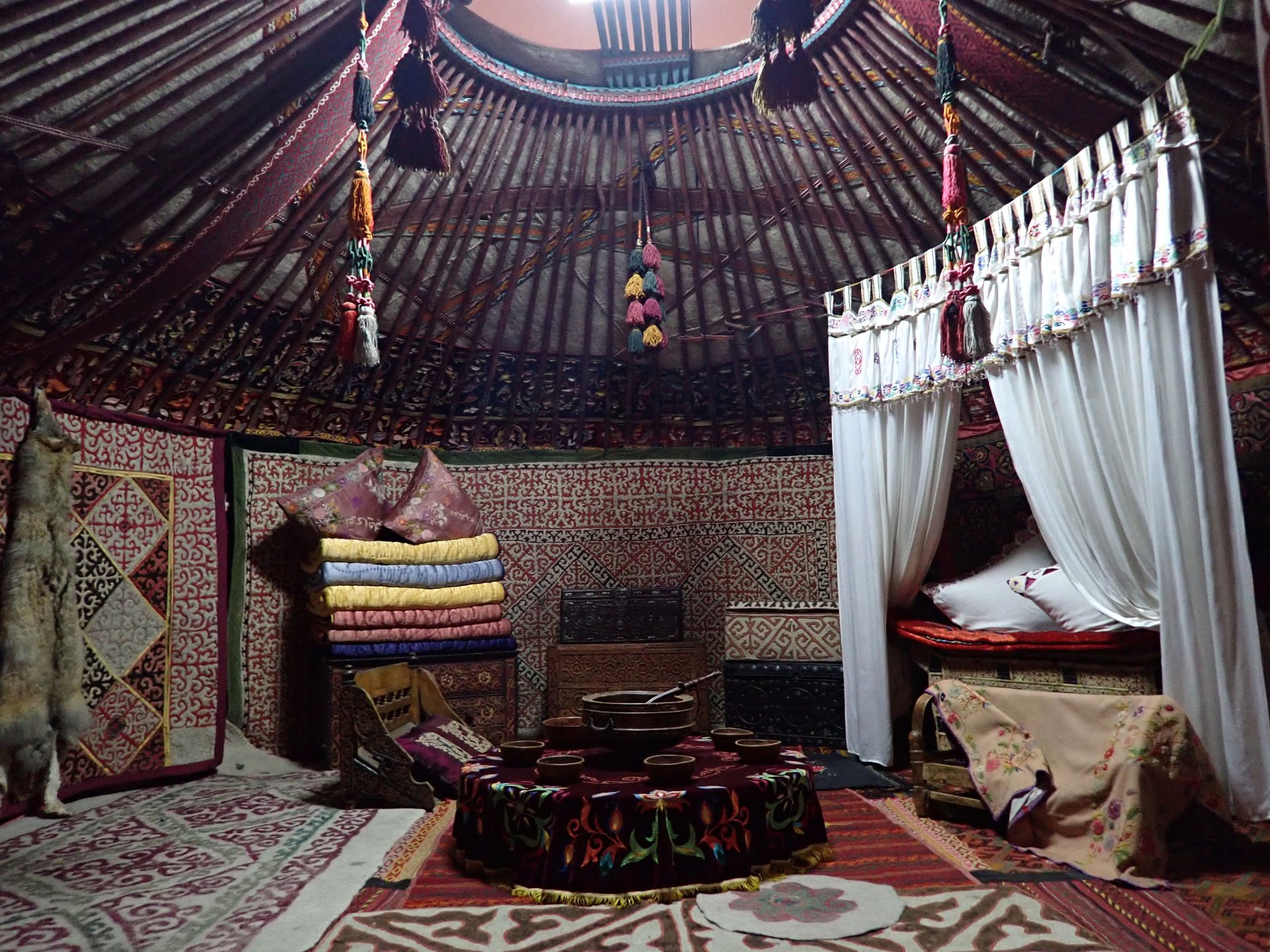
Centre of Nomadic Cultures for Environmental Education
An EDUNOMAD Project output
THE MUSEUM
CULTURAL INTERACTION AREA
RESEARCH DEPARTMENT
Although humans have lived as nomads for far longer than they have lived in settled communities, surprisingly, there is no institution dedicated exclusively to raising awareness of these cultures as a whole, let alone to helping them in their desire to preserve their way of life. At best, there are departments within international organisations (FAO, IUCN) that support groups of communities, particularly pastoralist communities.
Nomadic ways of life are showcased in numerous museums around the world, but always in a partial manner and frequently portraying an earlier stage of human existence that ‘has been surpassed’, as if everything were designed from the outset to produce nations and urban communities as the supreme achievement of human evolution – save for the detail that this evolution is leading us into a climate crisis due to the damage caused to ecosystems and the atmosphere itself.
We urgently need to restore a certain balance between natural ecosystems and urban areas, given the voracity of the latter, and to this end environmental education is a priority. And who better to teach us than Nomadic Peoples, the only humans who known how to live in the world without transforming its essence.
A pioneering initiative designed to raise awareness in Europe
Concept
The Centre for Nomadic Cultures and Environmental Education is a unique and truly innovative initiative on a global scale, as it involves the creation of the world’s first environmental education centre that places indigenous communities with nomadic traditions at its heart.
Areas of Activity
The EDUNOMAD Centre’s operational plan is defined by three areas of activity:
The permanent area of environmental education, which takes place at the Museum of Nomadic Cultures
The area of Research and Cooperation, which links the Centre with relevant external institutions to better study communities and ecosystems and elaborate projects
The area of Cultural Interaction, which includes activities both within and outside the Centre aimed at promoting cultures with a nomadic tradition in the Western World
Background
The Centre for Nomadic Cultures for Environmental Education represents the ultimate goal of the EDUNOMAD project, which has been running since 2022. This project focuses on visiting a wide variety of nomadic communities—still active today—across the globe, and discovering how they interact with their own natural ecosystems, as well as those who settled, or were forced to do so, but which retain some of the traditions characteristic of their culture.
1. Museum of Nomadic Cultures
2. Area of Research and Cooperation
The Museum of Nomadic Cultures would be the first museum of its kind in the world. The thematic framework chosen for the layout of the galleries divides the nomadic-tradition communities into five types of landscape that have shaped their existence: aquatic, forested, grassy, mountainous and desertic. These are in turn subdivided by climate into a total of ten thematic zones, plus a General Gallery and an additional gallery dedicated to itinerant groups in urbanized areas, resulting as follow:
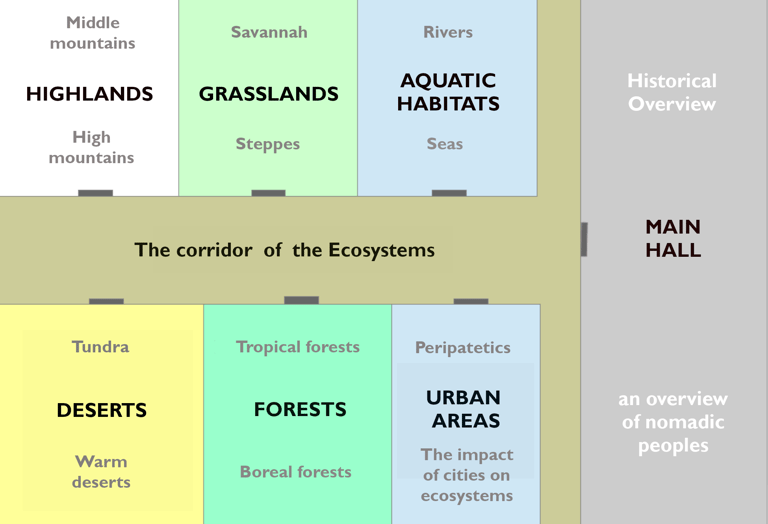
The General gallery provides an overview of nomadism throughout history and in the present day
The corridor of the Ecosystems illustrates the different ecosystems in which nomads lived and still live
The Highlands gallery: Dedicated to pastoral communities in the mid- and high-mountain regions of Europe, Asia and South America.
The Grasslands gallery includes equestrian groups of Eurasia and North America and peoples of the African savannah.
The Aquatic Habitats gallery includes those nomads dependent on marine and river resources, mainly in Southeast Asia.
The Desert gallery is dedicated to hunter-gatherers and pastoralists in areas with sparse vegetation (Asia, Africa, Australia)
The Forest gallery includes peoples from warm forests (Asia, Africa, South America) and boreal forests (Eurasia and North America).
Urban Areas gallery is Dedicated to itinerant or peripatetic communities and the impact cities have on natural ecosystems
Thematic map of the Museum of Nomadic Cultures
As mentioned above, the Research and Cooperation Department acts as a link between the Centre and relevant external institutions, ensuring constant contact with the communities and ecosystems in question, as well as with the institutions in the countries where they are located. It comprises a library and a department staffed by a number of specialist researchers, and is open to students and experts from any country.
Its main aim will be to develop cooperation projects to support communities with a nomadic tradition and to submit them to funding and decision-making bodies, both international and in the countries where the projects are to be implemented
3. Area of Cultural Interaction
This department is responsible for interacting with visitors to the centre and manages a range of services:
1. Information and guidance
2. Temporary Exhibition Gallery, where various artists will be able to exhibit their work relating to the world of nomads
3. Conference and Events Hall, where talks, discussions, film screenings and presentations will take place
4. Meeting room, where meetings and workshops will be held
5. Break room and café
6. Book and craft shop
7. Outdoor tent camp, specially designed to welcome primary, secondary and university students, who will learn about different types of nomadic accommodation and enjoy discussions, games and other outdoor activities